What Happens During Removal
| What happens |
What it means for you |
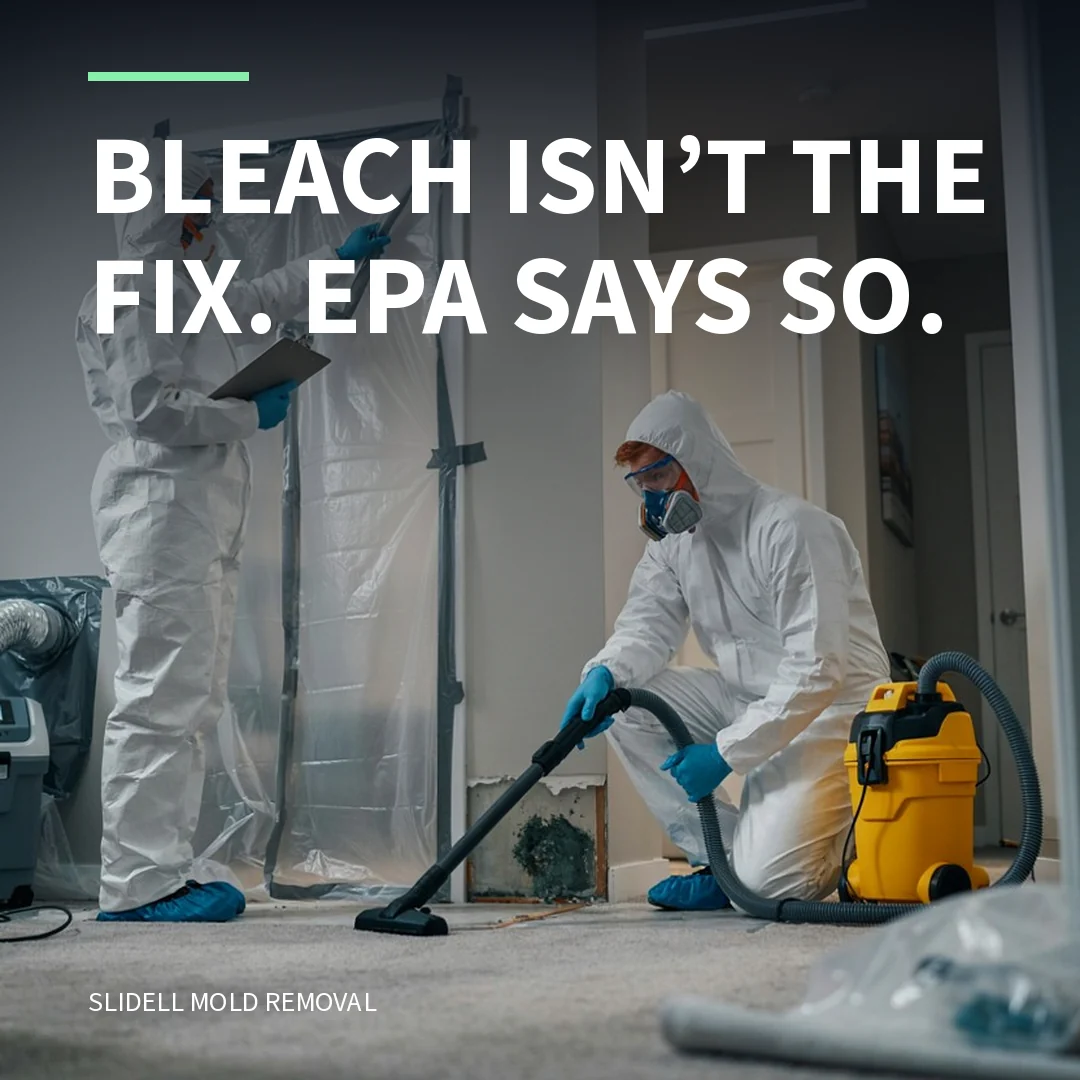
| The affected area is sealed off with plastic and put under negative pressure |
Spores stay in the space we’re working in and don’t drift into the bedrooms |
| Drywall, insulation, carpet pad, and trim that got wet and moldy come out; studs, joists, and masonry get cleaned where they stand |
The material that can’t be saved leaves; the structure that can stays |
| Everything removed is bagged inside the containment before it moves through the house |
No open bags of moldy drywall going down your hallway |
| Cleaned surfaces get HEPA-vacuumed and wiped, then the framing dries before rebuild |
Nobody hangs new drywall over damp wood |
| We identify where the water got in and tell you what has to change for the work to hold |
Removal with the same leak still running would just be a second job later |
| You receive a written report of what came out, from where, and why |
Louisiana law requires it, and a buyer, tenant, or adjuster will want it |
Before You Paint Over It
If the same stain keeps returning on the same wall, paint isn’t going to end it. A fresh coat changes the color for a few weeks while whatever is behind the drywall keeps going, because the water that fed it is still arriving. Scrubbing does the same thing on a shorter timeline: the surface looks fine, the growth inside the paper facing doesn’t care.
EPA says not to paint or caulk over mold, and it doesn’t recommend bleach as a routine practice either. Porous material that has been wet and moldy — drywall, insulation, carpet pad, ceiling tile — generally has to come out. Dead mold is still an allergen, so killing it isn’t the point. Getting it out of the house is.
What is different about mold in Slidell
Slidell is two kinds of town. South of I-10 and along the lake it’s waterfront: Eden Isle, Oak Harbor, Northshore Beach, and the canals off Bayou Liberty, where the 2005 surge came up out of Lake Pontchartrain and the Rigolets and sat in living rooms. Many of those houses were rebuilt or raised afterward, which means a newer slab or a fresh set of piers under a house that still has a story. North of the interstate it’s piney woods: Cross Gates, Hickory, Alton, out toward Pearl River — 1970s and 80s slab houses under tall pines, with roofs that catch every branch a storm throws and drainage that backs up when the Pearl runs high.
Katrina damaged roughly half a million housing units across Louisiana, and eastern St. Tammany took surge, not just wind. Sixteen years later Ida put roofs and attics through it again. Louisiana’s health department said the same thing after Ida that it said after Katrina: clean up mold only after every pathway for moisture into the structure has been closed. Plenty of houses got dried “well enough” and shut back up so families could move home. If one room has smelled off ever since, that’s a call worth making.
None of that changes what happens next. Whether the water came from the lake, the roof, or a pinhole in a copper line, the wet material comes out and the framing gets cleaned.
Worried About The Kids?
Here is what the health agencies actually say, without the scare tactics. CDC says exposure to damp and moldy environments may cause stuffy nose, sore throat, coughing, wheezing, burning eyes, or skin rash — or none of those, depending on the person. Louisiana’s Department of Health lists children, pregnant women, older adults, and people with asthma or weakened immune systems as the groups that may be more sensitive. EPA, CDC, and FEMA all say children should not take part in mold cleanup. CDC also says it doesn’t matter what kind of mold it is: all of it gets treated seriously and removed. If someone in the house has been coughing since the last storm, tell us when you call. It changes how we sequence the work.
Renting In Slidell?
Louisiana landlords carry the warranty against defects in the property whether or not they knew about the problem, and tenants can’t withhold rent for repairs that haven’t been made. Either way, the shortest path is the same: get the growth removed and get it written down. Landlords, the written report is your record. Tenants, tell us that’s your situation when you call — it changes how we document the job.
Selling A House With A Water History?
Louisiana’s required property disclosure form asks sellers directly about mold, mildew, water intrusion, and flooding, and in Slidell a lot of houses have an honest answer to give. An undisclosed problem a buyer finds later can become a rescission claim or a damages claim. A problem that was removed and documented is a line on the form and a report in the folder. If you’re listing this season, say so when you call.
Found Mold? Start Here.
We answer at any hour. Describe what you’re seeing or smelling, where it is, what got wet, and when the water problem started. If we’re available you’ll be connected right away; if we’re on a job you’ll get a scheduled callback, and we’ll tell you which number to watch for.
We take calls from Slidell, Pearl River, Lacombe, Eden Isle, Bayou Liberty, Olde Towne, Northshore Beach, Cross Gates, Oak Harbor, Alton, Bonfouca, and Hickory. The full list is on the areas page.
Mold after a roof leak? Tell us what happened.